Step 2a. Reroute after link breakage
Goals
The goal of this step is to demonstrate OSPF’s ability to automatically reroute traffic when a link fails.
OSPF continuously monitors link states. When a link fails, the affected router generates a new LSA reflecting the topology change and floods it throughout the area. Other routers update their LSDBs, rerun the SPF algorithm, and update their routing tables to use alternative paths (if available).
Configuration
This configuration is based on Step 1. The scenario manager script disconnects the link between R5 and R4 at t=60s.
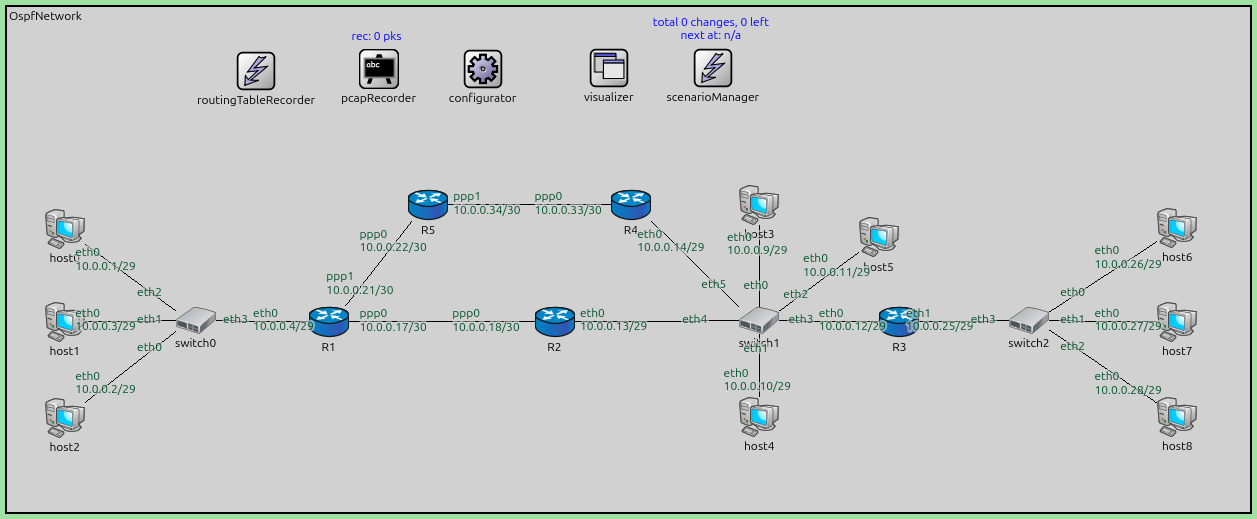
The configuration in omnetpp.ini is the following:
[Config Step2a]
description = "Reroute after link breakage"
extends = Step1

# the link between R5 and R4 breaks at t = 60s, and OSPF finds a new route

*.scenarioManager.script = xml("<scenario> \
                                    <disconnect t='70' src-module='R5' dest-module='R4' /> \
                                </scenario>")
Results
When the link between R5 and R4 breaks at t=70s:
Both R5 and R4 detect the link down event on their respective interfaces.
R5 and R4 each generate new Router LSAs that no longer include the link between them.
These LSAs are flooded throughout Area 0.0.0.0.
All routers receive the updated LSAs, update their LSDBs, and rerun the SPF algorithm.
Routers that were using the R5-R4 link in their shortest paths now compute alternative paths. For example, traffic from R1 to networks behind R4 now routes through R2 instead of through R5.
Applications may experience brief packet loss during the reconvergence period, but connectivity is restored once OSPF converges on the new topology. In this example, no ping packet is lost.
The routing table changes demonstrate OSPF’s resilience: when a link fails, the protocol automatically discovers and uses alternative paths, ensuring continued net work connectivity.
Sources:
omnetpp.ini,
OspfNetwork.ned
Discussion
Use this page in the GitHub issue tracker for commenting on this tutorial.