Step 7. BGP with RIP redistribution
Goals
Step 7 demonstrates BGP route redistribution from the Routing Information Protocol (RIP). While OSPF is a common IGP in modern networks, BGP is flexible enough to interact with several other routing protocols, including RIP.
In this scenario (BGP_Topology_4.ned), each Autonomous System uses RIP as
its internal routing protocol instead of OSPF. The border routers (RA4, RB1,
RB4, RC1) are configured to take the routes they learn from RIP and advertise
them to their BGP peers.
Key features demonstrated:
RIP as an IGP: All routers within each AS run RIP to discover internal subnets.
RIP-to-BGP Redistribution: The
redistributeRipparameter is set totruein the BGP configuration, allowing border routers to inject RIP-learned routes into the BGP table for advertisement to external ASes.Multiprotocol Interworking: Verifying that end-to-end connectivity is maintained when BGP is used to bridge multiple RIP-based domains.
Configuration
The topology remains the same as in Step 6 (BGP_Topology_4.ned).
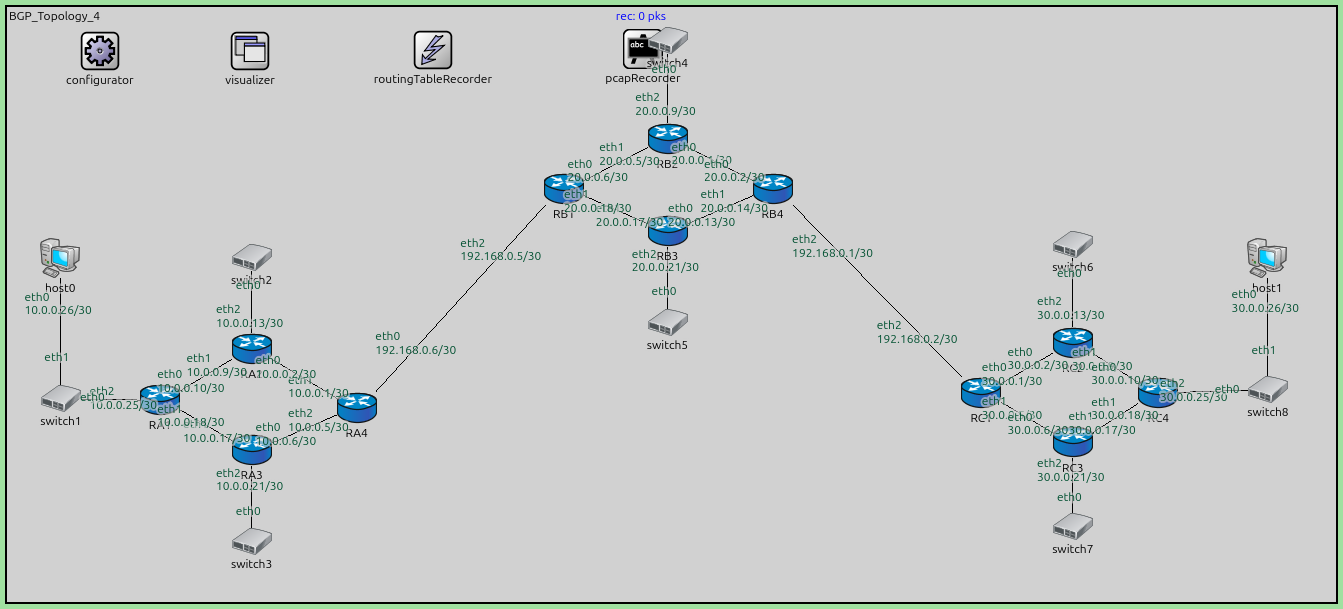
The configuration in omnetpp.ini enables RIP and disables OSPF:
[Config Step7]
description = "BGP with RIP redistribution"
network = BGP_Topology_4
*.routingTableRecorder.logfile = "step7.rt"

*.pcapRecorder.pcapFile = "step7.pcap"

*.configurator.config = xml("<config> \
                                <interface hosts='RA4' names='eth0' address='192.168.x.x' netmask='255.x.x.x'/> \
                                <interface hosts='RB1' names='eth2' address='192.168.x.x' netmask='255.x.x.x'/> \
                                <interface hosts='RB4' names='eth2' address='192.168.x.x' netmask='255.x.x.x'/> \
                                <interface hosts='RC1' names='eth2' address='192.168.x.x' netmask='255.x.x.x'/> \
                                \
                                <interface among='host0 RA*' address='10.x.x.x' netmask='255.x.x.x'/> \
                                <interface hosts='RA*' address='10.x.x.x' netmask='255.x.x.x'/> \
                                \
                                <interface hosts='RB*' address='20.x.x.x' netmask='255.x.x.x'/> \
                                \
                                <interface among='host1 RC*' address='30.x.x.x' netmask='255.x.x.x'/> \
                                <interface hosts='RC*' address='30.x.x.x' netmask='255.x.x.x'/> \
                                \
                                <route hosts='host*' destination='*' netmask='0.0.0.0' interface='eth0' /> \
                                \
                                <route hosts='RA4' destination='*' netmask='0.0.0.0' interface='eth0' /> \
                                <route hosts='RC1' destination='*' netmask='0.0.0.0' interface='eth2' /> \
                             </config>")

# RIP configuration
*.R*.hasRip = true
*.R*.rip.ripConfig = xmldoc("RIPConfig.xml")

# BGP configuration
*.RA4.hasBgp = true
*.RB1.hasBgp = true
*.RB4.hasBgp = true
*.RC1.hasBgp = true
*.R*.bgp.bgpConfig = xmldoc("BGPConfig_Redist.xml")
*.R*.bgp.redistributeRip = true

# enable BGP on RB2 and RB3
*.RB2.hasBgp = true
*.RB3.hasBgp = true
The BGP configuration uses redistributeRip = true:
*.R*.bgp.redistributeRip = true
Results
The simulation results in step7.rt confirm that RIP-learned routes successfully propagate via BGP:
RIP Convergence: Routers within each AS exchange RIP updates. For example, in AS 64700, RC1 learns about the networks connected to RC2, RC3, and RC4 via RIP.
Redistribution: RC1 takes these RIP routes (30.0.0.8/30, 30.0.0.12/30, etc.) and advertises them to its E-BGP peer, RB4.
BGP Propagation: RB4 receives these routes and advertises them via I-BGP to RB1, who then advertises them via E-BGP to RA4.
End-to-End Connectivity: Like in previous steps, all routers eventually learn routes to all possible destinations in the network. Routing table entries for 30.x.x.x networks appear in AS 64500 routers, and vice-versa, with BGP serving as the conduit.
This step shows that BGP’s redistribution mechanism is protocol-agnostic, making it a powerful tool for connecting diverse network islands.
Sources: BGP_Topology_4.ned,
omnetpp.ini,
RIPConfig.xml,
BGPConfig_Redist.xml
Discussion
Use this page in the GitHub issue tracker for commenting on this tutorial.