Step 16. OSPF topology change in multi-area OSPF
Goals
The goal of this step is to examine how OSPF reacts to network topology changes in a multi-area environment and how LSA updates propagate across area boundaries.
When a link fails in a multi-area OSPF network, the affected router generates new LSAs to reflect the topology change. These LSAs are flooded within the area, and ABRs generate updated Summary LSAs to propagate the change to other areas. This step demonstrates the cascading effect of topology changes through the hierarchical OSPF structure.
Configuration
This configuration is based on step 14. The simulation script disconnects the link between R1 and switch1 at t=60s, which isolates host1 from the rest of the network.
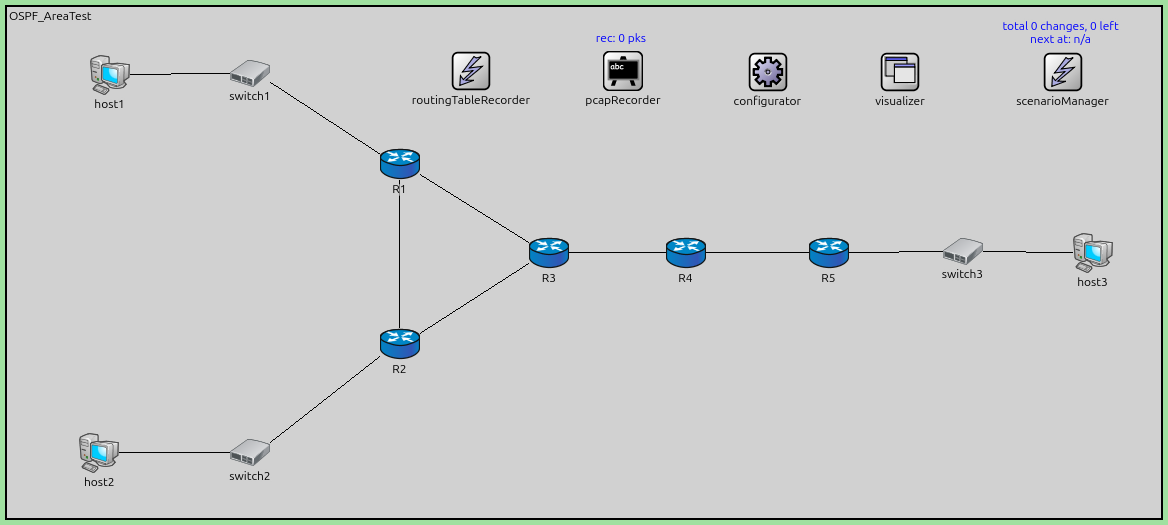
The configuration in omnetpp.ini is the following:
[Config Step16]
description = "OSPF topology change in multi-area OSPF"
extends = Step14

*.scenarioManager.script = xml("<scenario> \
                                    <disconnect t='60' src-module='R1' dest-module='switch1' /> \
                                </scenario>")

*.visualizer.routingTableVisualizer.destinationFilter = "R* or host1"

# application parameters
*.host2.numApps = 1
*.host2.app[0].typename = "PingApp"
*.host2.app[0].destAddr = "host3"
*.host2.app[0].startTime = 60s
Results
When the link between R1 and switch1 breaks at t=60s:
R1 detects the link down event on its eth0 interface.
R1 generates a new Router LSA that no longer includes the link to the 192.168.11.0/30 network (the network containing host1).
This Router LSA is flooded within Area 0.0.0.1 to R2 and R3.
R2 and R3 update their LSDBs and run the SPF algorithm. They remove the route to 192.168.11.0/30 from their routing tables because it was reachable only via R1.
R3 (as an ABR) regenerates Summary LSAs for Area 0.0.0.1 that it advertises into Area 0.0.0.0. The Summary LSA for 192.168.11.0/30 is withdrawn because no other path exists.
R4 (the other ABR) receives the updated Summary LSAs from R3 via the backbone and updates its LSDB and routing table accordingly.
R4 then generates new Summary LSAs to advertise into Area 0.0.0.2, informing R5 about the topology change.
R5 updates its routing table to remove the route to 192.168.11.0/30.
The routing table visualizer output shows that at t=60s, the 192.168.11.0/30 network becomes unreachable from all other routers in the network. The routing table changes propagate through the multi-area hierarchy: first within Area 0.0.0.1 (intra-area), then across the backbone (inter-area), and finally to Area 0.0.0.2 (inter-area).
This demonstrates how OSPF’s hierarchical design efficiently propagates topology changes across area boundaries using Summary LSAs, while containing the detailed topology changes (Router LSAs) within their originating area.
Sources:
omnetpp.ini,
OSPF_AreaTest.ned
Discussion
Use this page in the GitHub issue tracker for commenting on this tutorial.