Step 10b. Router R2 (DROTHER) goes down
Goals
The goal of this step is to demonstrate what happens when a DROther router fails on a multi-access network.
When a DROther (a router that is neither DR nor BDR) fails, the impact is limited since DROthers do not have special responsibilities in the OSPF protocol operation. The DR and BDR are unaffected, and the multi-access network continues to operate normally.
Configuration
This configuration is based on Step 10. The simulation script shuts down router R2 (a DROther) at t=60s.
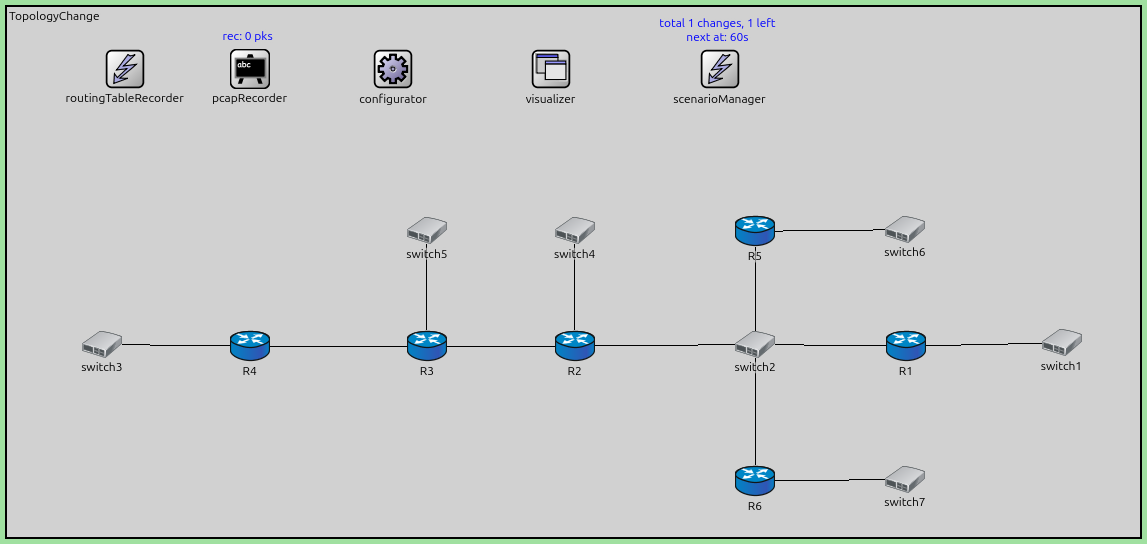
The configuration in omnetpp.ini is the following:
[Config Step10b]
description = "Router R2 (DROTHER) goes down"
extends = Step10

*.scenarioManager.script = xml("<scenario> <at t='60'> <shutdown module='R2'/> </at> </scenario>")

# application parameters
*.R3.numApps = 1
*.R3.app[0].typename = "PingApp"
*.R3.app[0].destAddr = "R4"
*.R3.app[0].startTime = 60s

*.R1.numApps = 1
*.R1.app[0].typename = "PingApp"
*.R1.app[0].destAddr = "R6"
*.R1.app[0].startTime = 60s
Results
When R2 (a DROther) is shutdown at t=60s:
The DR and BDR on Switch2 detect that R2 has failed when Hello packets stop arriving.
The DR generates a new Network LSA for Switch2 that no longer lists R2 as an attached router.
Other routers adjacent to R2 on other interfaces also detect the failure and update their LSAs accordingly.
The topology change is flooded throughout the area.
Importantly, no DR/BDR re-election occurs on Switch2. The existing DR and BDR continue their roles.
In general, Routing around the failed router is recomputed using alternative paths, if available.
This demonstrates that DROther failures have minimal impact on the OSPF protocol operation on multi-access networks.
Sources:
omnetpp.ini,
TopologyChange.ned,
ASConfig_tp_priority.xml
Discussion
Use this page in the GitHub issue tracker for commenting on this tutorial.