Step 5a. BGP internal distribution
Goals
Step 5a presents the first solution to the “BGP Hole” problem identified in Step 5. By enabling redistribution of BGP internal routes into the Interior Gateway Protocol (OSPF), we ensure that non-BGP speakers within the transit AS learn how to reach external destinations.
In this configuration, the redistributeInternal attribute is set to true
on border routers RB1 and RB2. This instructs the BGP module to take routes
learned from I-BGP peers and inject them into the local OSPF instance.
Configuration
This step extends Step 5.
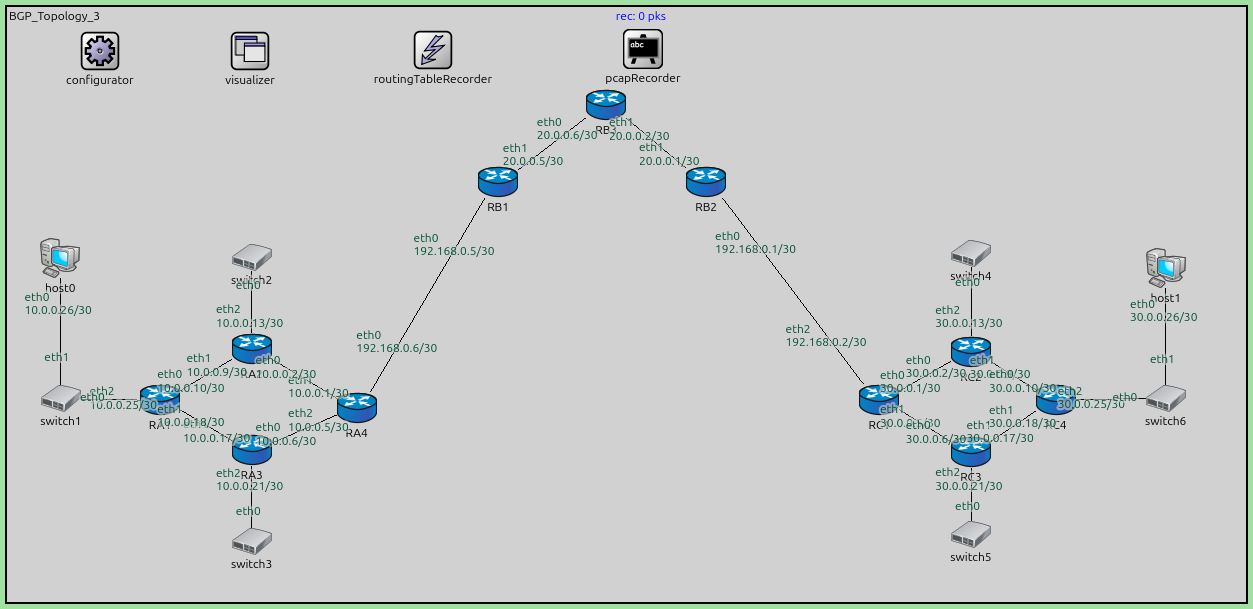
The key change in omnetpp.ini is:
*.RB{1,2}.bgp.redistributeInternal = true
The configuration in omnetpp.ini is the following:
[Config Step5a]
description = "BGP internal distribution"
extends = Step5
*.routingTableRecorder.logfile = "step5a.rt"

*.pcapRecorder.pcapFile = "step5a.pcap"

# BGP routes are distributed internally within the AS
*.RB{1,2}.bgp.redistributeInternal = true
Results
With internal redistribution enabled, we can observe the following in step5a.rt:
RB1 and RB2 continue to exchange routes via I-BGP.
RB1 redistributes the routes it learns from RA into OSPF.
RB3 receives these routes via OSPF. Check RB3’s routing table (20.0.0.6) and you will see entries for the 10.0.0.x and 30.0.0.x networks.
Reachability is now established: packets from AS 64500 to AS 64700 can successfully transit RB3 because RB3 now has OSPF routes to those external subnets.
While this approach works for small networks, it is generally discouraged in large-scale internet routing because it can overwhelm the IGP with a massive number of external routes.
Sources: BGP_Topology_3.ned,
omnetpp.ini,
OSPFConfig_Multi.xml,
BGPConfig_Multi.xml
Discussion
Use this page in the GitHub issue tracker for commenting on this tutorial.