Step 1. The Problem: Broadcast Loops Without STP
Goals
Before learning how STP solves the problem, it is important to understand what happens in a bridged Ethernet network with redundant links but without STP. This step demonstrates that loops in a switched network cause frames to circulate indefinitely, creating a broadcast storm that prevents reliable communication.
Background
Ethernet switches (also called bridges in the IEEE 802.1D standard) forward frames based on destination MAC addresses. When a switch receives a frame, it looks up the destination address in its MAC forwarding table (also called filtering database). If the address is found, the frame is sent out the corresponding port; if not, the frame is flooded — sent out all ports except the one it arrived on. Broadcast and multicast frames are always flooded.
Switches build their forwarding tables automatically through MAC learning: when a frame arrives on a port, the switch records the frame’s source MAC address and the port it arrived on. Over time, the table is populated with entries that map each known host address to a specific port.
In enterprise and data-center networks, redundant links between switches are common — they protect against individual link or switch failures that would otherwise partition the network. However, redundant links inevitably create loops in the network topology, and as this step demonstrates, loops and the flood-and-learn mechanism are a dangerous combination.
The Network
The simulation uses the LoopNetwork network, which contains three Ethernet
switches (switch1, switch2, switch3) connected in a ring, with two
hosts (host1 and host2) attached to switch1 and switch3
respectively.
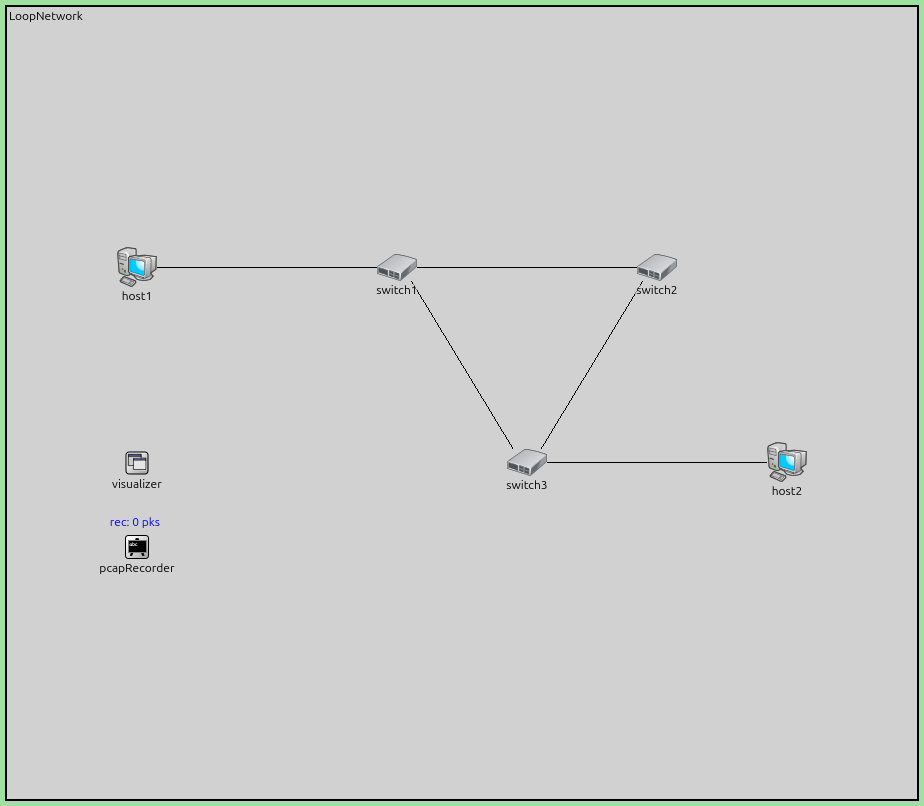
The ring topology provides redundant paths between the hosts (host1 can reach
host2 via switch1→switch2→switch3 or directly via switch1→switch3),
but without STP, both paths are active simultaneously, causing loops.
Configuration
The configuration is in the Step1 section of omnetpp.ini:
[Config Step1]
description = "Broadcast loops without STP"
network = LoopNetwork
sim-time-limit = 20s

# Fixed MAC addresses so we can set destAddress
**.switch1.**.address = "AAAAAA000001"
**.switch2.**.address = "AAAAAA000002"
**.switch3.**.address = "AAAAAA000003"

# host1 sends frames to host2 continuously
**.host1.cli.destAddress = "host2"
**.host1.cli.startTime = 0s
**.host1.cli.sendInterval = 1s
No STP is enabled (there is no hasStp setting). host1 sends Ethernet
frames to host2 every second.
Results
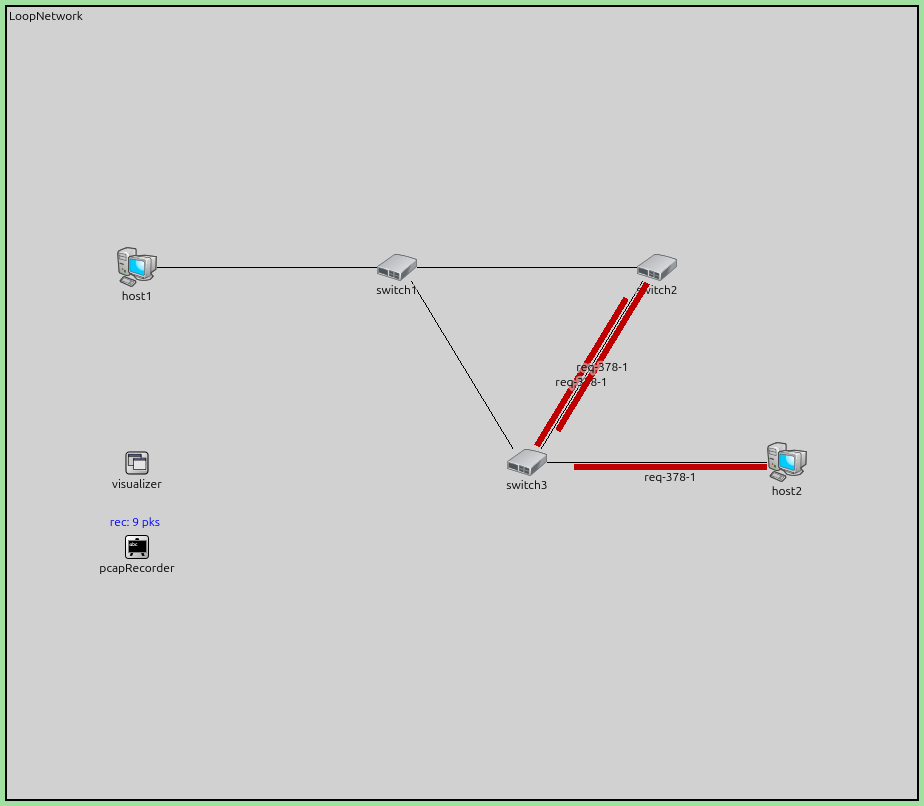
When host1 sends a frame to host2, switch1 does not yet know which
port leads to host2, so it floods the frame out all other ports. The frame
arrives at both switch2 and switch3. Neither switch knows host2’s
location either, so both flood the frame further — creating two copies
circulating in opposite directions around the ring.
Each time a switch receives one of these circulating copies, it floods it again, causing the number of frame copies in the network to grow exponentially. This is a broadcast storm.
The loop also causes MAC table instability. Consider the path of
host1’s frame: when it first arrives at switch3 directly from
switch1, the switch learns that host1 is reachable via the port
connected to switch1. Moments later, the same frame arrives at
switch3 from switch2 (having gone the long way around the ring), and
the switch overwrites its table entry to say host1 is reachable via the
switch2 port. This oscillation repeats continuously with each circulating
copy, making the forwarding table useless.
As a result, host2 receives many duplicate copies of each frame sent by
host1, and communication is completely unreliable.
The next step shows how STP solves this problem by logically breaking the ring.
Sources:
omnetpp.ini,
StpTutorial.ned
Discussion
Use this page in the GitHub issue tracker for commenting on this tutorial.